How NRPs Are Compatible with MPD
With over 30 successful jobs and 10,000+ NRPs stripped through RCD elements in the Gulf of America, WWT has proven compatibility with nearly all major RCD suppliers.
Non-Rotating Protectors (NRPs) are clamp-on style sleeves installed on drill pipe to reduce casing wear, torque, and drag by isolating drill pipe rotation from the wellbore.
When used with Managed Pressure Drilling (MPD) systems, NRPs may need to strip through the Rotating Control Device (RCD) under pressure during drilling or tripping phases. NRPs are designed to mitigate risks associated with this stripping operation through key features, including:
- High-strength collar bolts with increased torque for greater axial grip strength
- Collar seals for reduced leakage
- Slim-profile sleeves for reduced RCD stress
- Low-friction sleeves for smooth stripping
GOA Case Study: 650 psi SBP on Drillship at 4,000 ft Water Depth
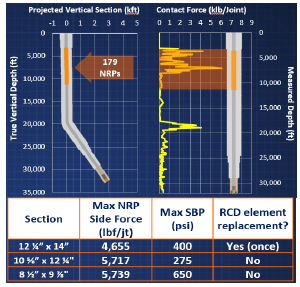
NRPs provided casing wear and heat-checking mitigation over shallow doglegs while drilling the last three hole sections of a Gulf of America (GOA) deepwater well.
All 179 NRPs were stripped through the Rotating Control Device (RCD) after each hole section, with a maximum Surface Back Pressure (SBP) of 650 psi.
After more than 1,000 passes through the dual-element RCD, all NRPs:
- Remained in good condition
- Stayed securely attached to the drill pipe
- Exhibited negligible leakage while traversing through the RCD
GOA Case Study: 6,000+ RCD Stripping Passes on a Deepwater Well
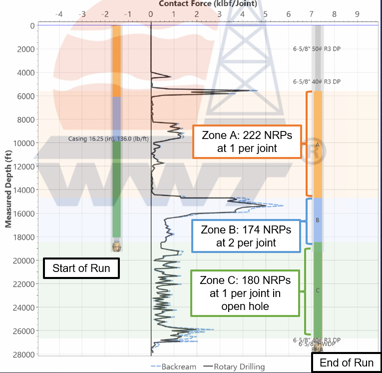
A deepwater offshore well required casing protection due to a shallow dogleg and build section. A total of 576 slim-profile NRPs were installed to protect the casing while drilling under Managed Pressure Drilling (MPD) conditions. The slim-profile design was specifically selected to ensure compatibility with the Rotating Control Device (RCD).
The well was drilled using MPD with approximately 330 psi Surface Back Pressure (SBP). The NRPs were successfully run and stripped through the RCD more than 6,000 times without compromising pressure control or tool integrity. The operation reached total depth with no casing damage and no MPD-related issues, demonstrating effective integration of NRPs within an MPD system.
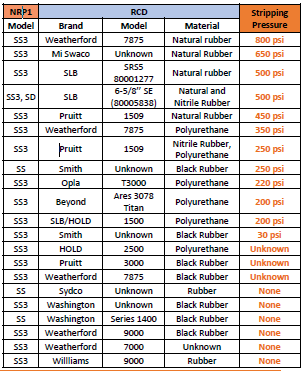
The table to the right summarizes the known work history of successfully running NRPs through various RCDs, many with hundreds of stripping passes. While many additional passes may have been performed at lower pressures, only the maximum stripping pressure is shown.
General Compatibility Guidelines
In general, NRPs are compatible with an RCD if the SBP while stripping is below 400 psi. However, higher pressures can be accommodated depending on the RCD element material and the equipment being used.
Standard Procedures for New RCD Systems
Standard operations with any new RCD system include:
- Verifying that the RCD's absolute maximum pass-through diameter is greater than the NRP sleeve outside diameter (OD)
- Ensuring there are no sharp edges on the NRPs
- Applying lubricant to the NRPs to facilitate smoother stripping
- Test stripping a minimum of one stand of NRPs down and back up through the RCD
If the RCD model or element material is not included in the known work history, or if the conditions above cannot be met, please contact a WWT representative to discuss available solutions, including:
- Custom OD sleeves
- Extreme-grip collars
- Additional compatibility testing to ensure safe and reliable operation
NRP Collars with Increased Grip
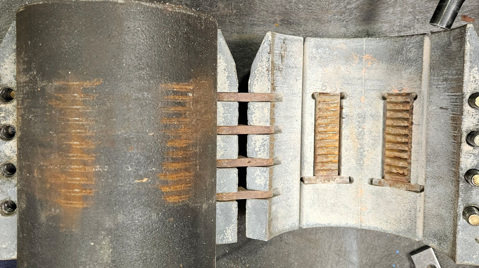
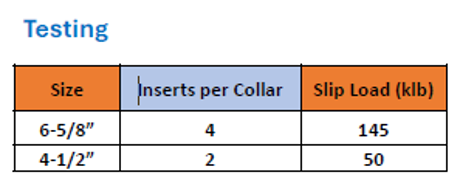
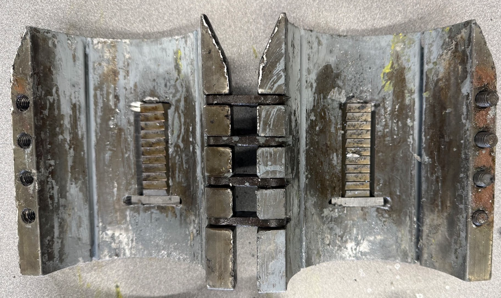
For wells with high RCD back pressure, NRP collars with gripper inserts (slip dies) are available to provide 50–145 klb of holding force—3–10× greater grip than standard collars.
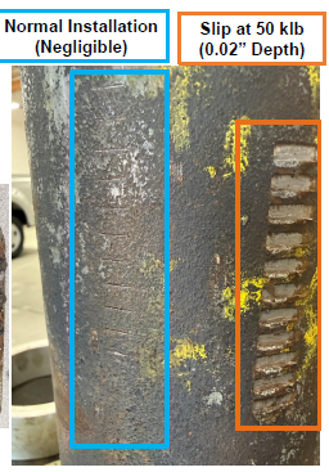
The depth of the slip die teeth is controlled to a maximum of 0.020 in. to ensure they do not affect the integrity of the drill pipe.