No Casing Wear Detected After More than 9 Months of Drilling in a HP/HT Well
Casing Wear Concern
This exploratory (HP/HT), onshore well was originally planned to be drilled to 6,500m total depth (TD), making it one of the deepest wells in the country. In addition, the historically low ROP of 1 m/hr and long exposure of production casing to drill pipe rotation caused a concern for casing wear. WWT Non Rotating Protectors (NRPs) were deployed as a solution.
Results
Due to the geological uncertainty of this exploratory well, TD was extended by 1,463m from its original depth to 7,963m.
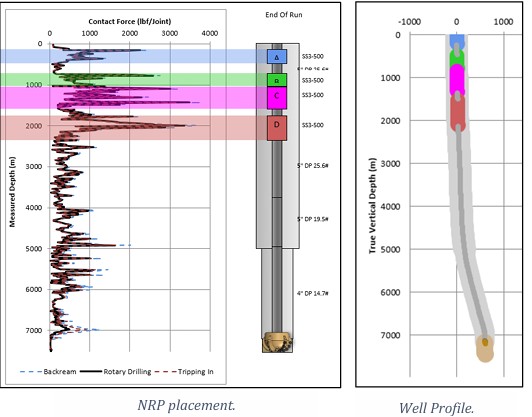
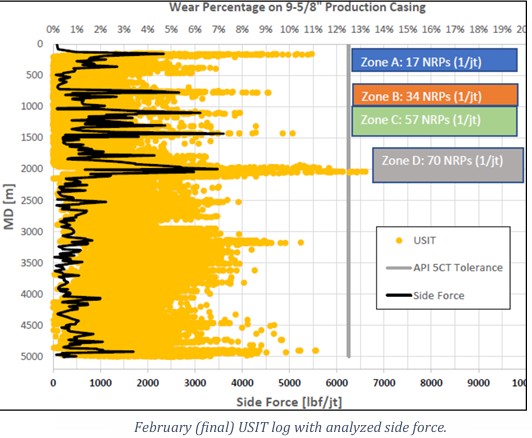
Over a course of 9 months, the drilling operations inside the production casing accrued a total of approximately 11.3 million drill pipe revolutions with an average ROP in the 8 ½” and 6” hole sections of 1.3 m/hr. Two USIT logs taken in November 2018 and February 2019 show that NRPs mitigated casing wear
local to where they were installed, particularly in high side force areas of up to 3,500 lbf/joint. The use of NRPs allowed the customer to reach beyond their planned TD, maintaining the integrity of their production casing.
Only a 0.7% increase at the maximum wear point occurred in the 4 million revolutions between the 2 USIT logs, which peaked at 13.2%. In comparison, up to 80% casing wear could have occurred without the use of NRPs, with multiple areas over 60%. This high amount of wear would have prohibited further drilling,
and the well would not have been suitable for gas production.