Torque reduction in 3-mile Powder River Basin lateral using NRPs
Drilling extended-reach laterals in harsh downhole environments presents a host of technical challenges, especially in abrasive formations. Excessive rotary torque can often exceed the drill pipe torsional limits.
Client challenge
An operator in the Powder River Basin faced challenges with high torque, which not only was modelled to exceed the MUT of the drill pipe but its abrasive nature has caused significant drill pipe damage on previous wells without NRPs. The operator needed a solution to mitigate these issues and prevent equipment DBR charges while drilling a three-mile lateral through this abrasive formation.
Our solution
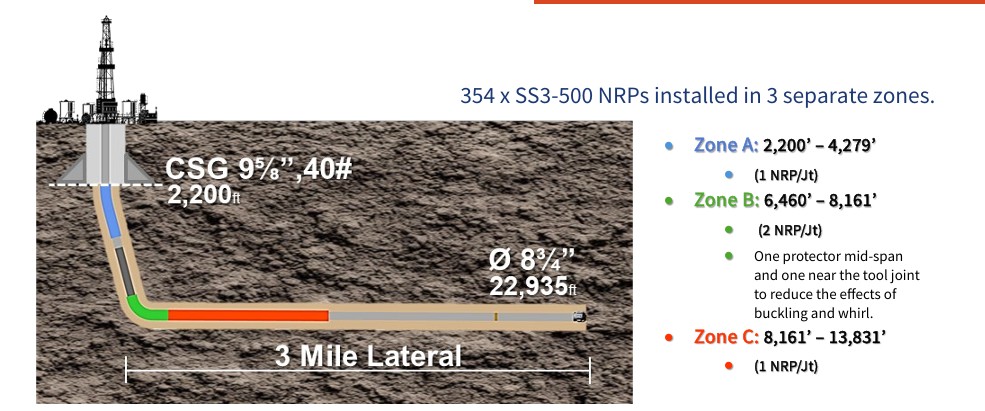
354 WWT Non-rotating protectors, featuring low-friction additives which operate off WWT’s patented fluid bearing design were installed. The NRPs were used for the main bore 8 3/4” drilling section totalling a run length of 9,102’ and having NRPs in over 11k feet of open hole.
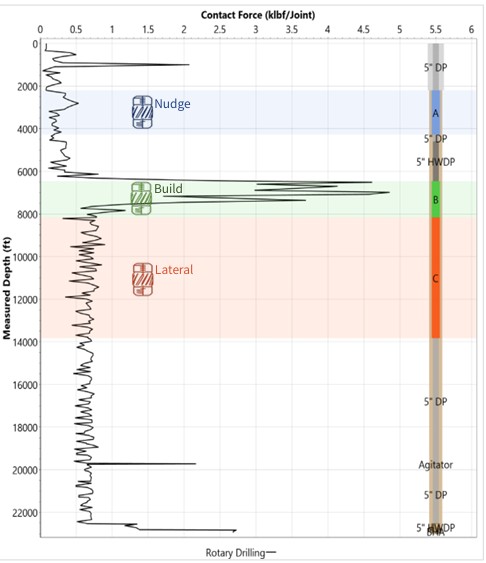
WWT NRPs are engineered to minimize torque by reducing friction between the drill string and the wellbore. This is achieved through strategic placement in high side-force zones and the use of low-friction polymer materials that provide consistent standoff from the open hole wellbore.
Drilling Torque
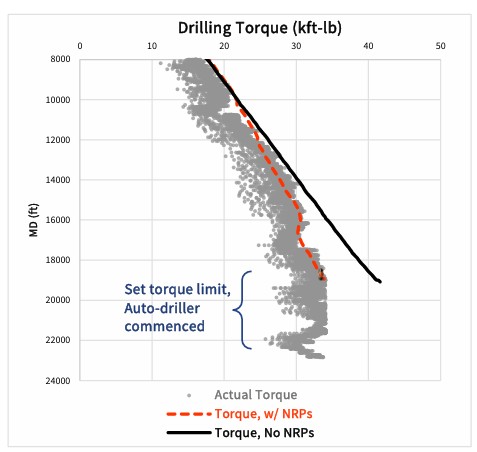
Deployment of WWT Non-Rotating Protectors (NRPs) resulted in a substantial reduction in surface torque during drilling of a three-mile lateral. Measured torque with NRPs reached 34,000 ft-lb, compared to
simulated torque levels of up to 42,000 ft-lb without NRPs—demonstrating a 20% reduction.
The use of NRPs was essential to reducing torque to levels manageable by the auto-driller, without which drilling this lateral section to total depth would not have been possible.
Hook Load
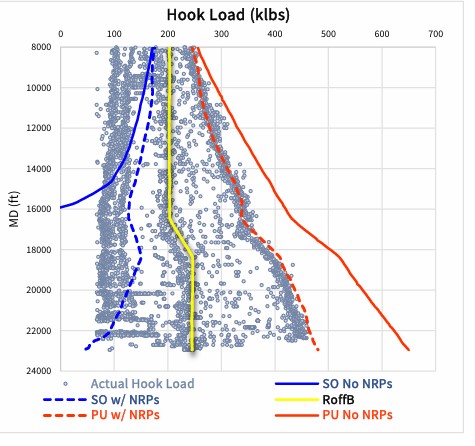
The hook load analysis clearly demonstrates the effectiveness of WWT’s Non-Rotating Protectors (NRPs) in reducing frictional drag along the lateral section. Simulations without NRPs show significantly higher
pick-up weights and lower slack-off weights, resulting in a wide PU–SO separation that reflects inefficient weight transfer to the bit. In contrast, the inclusion of NRPs narrows this gap substantially, indicating
improved axial load transfer and reduced torque and drag. The actual hook load measurements align more closely with the NRP-adjusted simulations, validating that NRPs provided a measurable reduction in
drag, enhanced weight-on-bit delivery, and overall improved drilling efficiency in the lateral wellbore.