WWT NRPs Reduce Torque up to 50% in Direct Comparison
Executive Summary
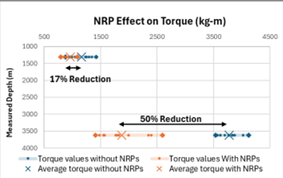
An Asia-Pacific operator expected to face torque issues on a series of directional wells and wanted to test WWT NRP’s torque reduction in a direct comparison at three depths of interest. Torque with NRPs was17% lower at 1,310m, 50% lower at 3,623m, and 18% lower at TD than torque without NRPs.
Comparison Method
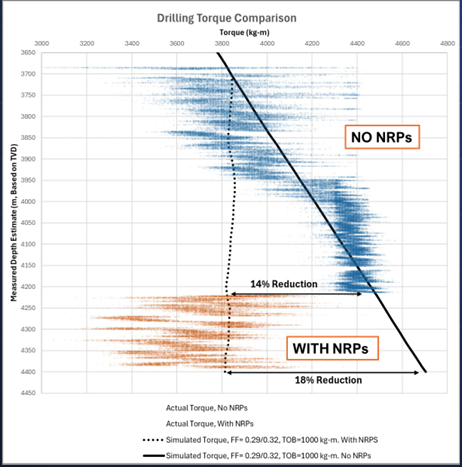
Torque with and without NRPs was compared at various flow rates and RPMs to confirm NRPs performance. Flow rate was 26-30l/s, rotation40-60RPM off bottom, string pickup and run in speed at3m/min. The same operations were repeated at the same depths of 1,310m and 3,623m with and without NRPs on the same drill string. Since drilling operations cannot be replicated on the same well at the same depths, comparison was done between drilling from 3,653m to 4,216m without NRPs and drilling from 4,216m to 4,400m with NRPs. Friction factor back modelling simulations were used for the drilling comparison.
NRPs showed on average 17% torque reduction at 1,310 m, and 50% torque reduction at 3,623 m, as shown in the graph above. This comparison was done all in cased hole and data was noted after torque values stabilized. This proves the torque reduction using WWT NRPs.
Drilling results show a clear reduction in torque when NRPs were installed. Friction factors were back modeled to 0.29 cased hole and 0.32 open hole to match results without NRPs and still matched the results with NRPs at the same friction factors. This indicates that the local point friction factor reduction applied in the WWT analyses is accurate. NRPs showed a 14% immediate drop in torque when installed and are estimated to have reduced overall surface torque by 18% at TD.